When Food Becomes a Memory: The Story of Tantie Lorraine
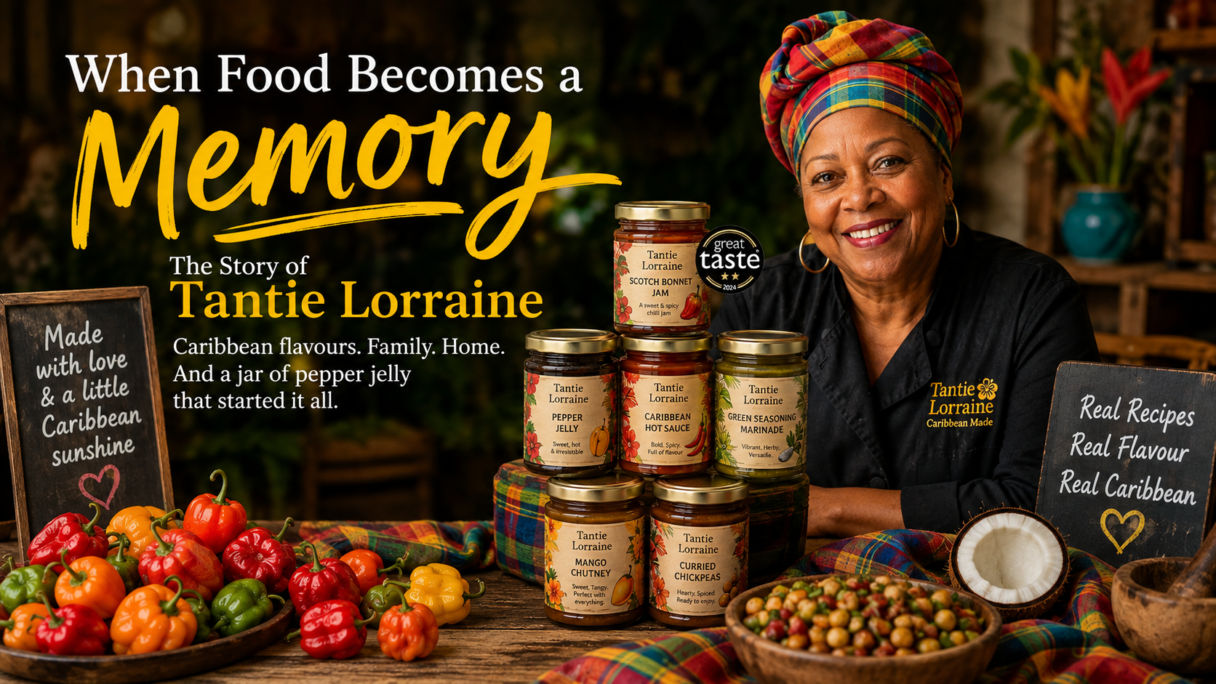
Food has a curious way of carrying memories that we don’t necessarily realise we’re collecting at the time. A smell from a kitchen, the taste of something cooked by a grandparent, a particular spice or a recipe that only ever seemed to exist in one person’s hands can sit quietly in the background for years, apparently forgotten, until something brings it back. Sometimes it is a meal, sometimes it is a smell drifting from somebody else’s kitchen and occasionally, as in the case of Beverly Lorraine Frederick, it is a jar of pepper jelly brought home from Trinidad.
That jar would eventually become part of the story of Tantie Lorraine, an independent Caribbean food business based in Surrey, producing sauces, jams, relishes, marinades and other small-batch products inspired by the flavours and traditions of Trinidad and Tobago. On the surface, it is another story about somebody turning a passion for food into a business, but spend a little longer with the story and it becomes something more interesting. It is about migration, family, memory and the strange way that food can provide a connection to somewhere that may be thousands of miles away.
Lorraine was born in Trinidad and Tobago, and her early relationship with food was shaped by the people and places around her. She has spoken about growing up with grandparents and extended family and spending time in the countryside, where food was not something that arrived neatly packaged from a supermarket shelf but something connected to the land, the seasons and the people working with it. Oranges, coconuts, cocoa, mangoes and vegetables were part of that world, along with the ordinary routines of family life that children tend not to recognise as particularly significant until much later. At the time, it was simply life. Looking back, those experiences became part of the culinary memory that she carried with her when she eventually found herself living in Britain.
That is perhaps one of the more interesting things about food. We tend to think we remember recipes, but what we actually remember is often much less precise and much more personal. We remember who cooked something, where we were when we ate it, what the kitchen smelled like and the particular taste that somehow seemed completely ordinary because it had always been there. Move away from home and those supposedly ordinary things can become surprisingly difficult to replace. You can find something similar, perhaps, but “similar” isn’t always good enough when what you’re really looking for is a taste that belongs to somewhere else.
At some point Lorraine returned to Trinidad and brought pepper jelly back with her to Britain. Eventually, predictably enough, the jar was emptied. The slightly less predictable part came afterwards. She couldn’t find anything in Britain that gave her the same experience, so she decided to make her own. It is a wonderfully simple starting point for a food business because there was no grand commercial proposition lurking behind it. There was simply a problem that needed solving… Lorraine wanted a particular food and couldn’t find it. The solution was to go into the kitchen and make it herself.
That is how quite a few genuinely interesting independent food businesses begin. Not with a market analysis explaining that consumers aged 35–54 have demonstrated an emerging preference for premium Caribbean condiments, but with somebody standing in a kitchen thinking, “Well, if nobody else is going to make it, I’ll have a go.” The difference may sound trivial, but it matters. There is something fundamentally different about a product that begins with a person’s own experience and eventually becomes something other people can buy. The commercial opportunity comes afterwards. The reason for making it already exists.
Lorraine’s homemade pepper products eventually found their way to a local farmers’ market, where the first batches sold out. That must have been a useful piece of market research, although thankfully nobody appears to have required a thirty-page strategy document to establish the conclusion. People liked the food. More importantly, they liked it enough to hand over money for it, which is generally the point at which a hobby starts becoming a business, whether the person involved is quite ready for that development or not.
From those beginnings, Tantie Lorraine grew into a wider food business, developing a range that includes Caribbean sauces, relishes, marinades, jams and other products. Scotch Bonnet peppers feature prominently, which will come as no surprise to anyone who has ever encountered one of the little things with anything resembling enthusiasm. The products have also received recognition through the Great Taste Awards, including two stars for the Scotch Bonnet Jam in 2024. That is a considerable achievement for a product whose origins can ultimately be traced back to a jar of pepper jelly brought home from Trinidad because someone wanted to taste it again.
Yet the chilli isn’t really the most interesting part of the story. It is simply the vehicle through which the story travels.
What makes Tantie Lorraine particularly appealing is the way the business connects food with the idea of home. We often use that word rather casually, but home isn’t always a house or even a country. Sometimes it is a collection of smells, sounds, people and routines that happened to surround us when we were young. For somebody who has moved between countries, those associations can become particularly powerful. Britain may become home in one sense, while Trinidad remains home in another. Food provides a rather effective bridge between the two.
You can see that in the name itself. “Tantie” is a familiar Caribbean term associated with an auntie or older female relative, carrying with it something of the warmth, familiarity and authority that comes with family. It is a much more personal name than most food brands manage to achieve, largely because it doesn’t appear to have been invented by a branding agency trying to manufacture authenticity. It sounds like someone you might actually know… and perhaps that is precisely why it works.
There is a wider point here about the independent food businesses that interest me. We have become surrounded by products that use words such as artisan, heritage, traditional and authentic with such enthusiasm that the words themselves have become almost meaningless. Walk into enough supermarkets, and you could be forgiven for thinking that every packet of biscuits has been hand-crafted by a seventh-generation family in a converted barn somewhere, preferably while rain falls gently against an old window.
The reality is rather more interesting when you find somebody who actually has a family history connected to the food they are making. With Tantie Lorraine, the cultural connection isn’t something added to the packaging because somebody decided it might help sell more jars. It is part of the reason the business exists. The recipes, flavours and ingredients come from a real place and from memories of real people, which gives the finished product a significance that goes beyond whether the sauce happens to taste good.
And, of course, it helps considerably if it does taste good.
That sounds obvious, but it is worth remembering. A good story can get somebody to pick up a jar once. It cannot necessarily persuade them to buy another one. Independent food businesses survive on that second purchase, and the third, and the customer who tells a friend about the thing they discovered at a market. The story gets attention, but eventually, the food has to do the rest of the work.
That is part of what makes farmers’ markets and independent food outlets so interesting. They provide a much more direct relationship between the person making something and the person eating it. There are fewer layers between the two. You can ask questions. You can hear where the recipe came from. You can find out why somebody started making a particular product. Sometimes the person standing behind the stall is the person who actually made it, which is an increasingly unusual experience in a food system that can involve an impressive number of people before something reaches a supermarket shelf.
Lorraine has also taken the story beyond the products themselves through Caribbean cooking workshops, sharing recipes, techniques and some of the history behind the food. That matters because traditional food is about considerably more than ingredients. A recipe can be written down, but much of the knowledge surrounding it is carried through observation and repetition. Someone shows you how much to use rather than weighing it. Someone tells you when it looks right. Someone explains why their family does it differently from the recipe you found in a book. Eventually, you realise that what you thought was a recipe was actually a small piece of cultural knowledge being passed from one person to another.
Once you look at food that way, small independent businesses begin to resemble something rather more valuable than simply places where you can buy lunch or a particularly good jar of chutney. They become little repositories of memory. They keep techniques alive, preserve flavours that might otherwise become harder to find and provide a way for people who have moved away from their original homes to maintain a connection with them. At the same time, they introduce those flavours to people who may never have travelled to the places from which they came.
That exchange has always been part of food culture. Britain has borrowed, adapted and transformed ingredients and recipes from all over the world for centuries, while people arriving here have brought their own food traditions with them. The result is the gloriously untidy thing we now call British food. It is worth remembering that food has never been particularly interested in the neat categories that people occasionally try to impose upon it. Recipes travel. Ingredients travel. People travel. Eventually, somebody puts two things together that their grandmother would probably have regarded as mildly suspicious, and the rest of us decide it is traditional.
The story of Tantie Lorraine fits comfortably into that much larger history, but there is still something very personal about it. A woman living in Britain wanted to recreate a flavour that reminded her of Trinidad. She couldn’t find it, so she made it. Other people tasted it, liked it and wanted some themselves. What began as a personal connection to home gradually became a business that now allows other people to experience a little of that same culinary tradition.
That is the bit of independent food culture I find most interesting. We hear an awful lot about entrepreneurship these days, usually accompanied by photographs of somebody holding a coffee in front of a laptop and talking about their “journey”. Real businesses are generally rather less glamorous. They involve buying ingredients, washing equipment, worrying about packaging, doing markets, complying with regulations, answering customers, making another batch when you really don’t feel like making another batch and discovering that there are considerably more things to think about once other people start paying you for your food.
There is a quiet courage in doing that. Making something for yourself is one thing. Putting it in a jar, attaching your name to it and asking a stranger to spend their money on it is another matter entirely. The first customer is buying the product. Somewhere underneath that transaction, though, they are also saying that what you have made is worth something to them.
For someone like Lorraine, that must carry an additional significance because the thing being sold is so closely connected to her own history. Every bottle and jar represents not just a recipe but a piece of somewhere else… a reminder that food can cross borders rather more successfully than many of the people who make it.
Perhaps that is why I think Tantie Lorraine is the sort of independent food story worth telling. It isn’t really a story about a clever product range or a particularly successful piece of branding, although both undoubtedly matter when you’re running a business. It is a story about what happens when somebody refuses to let a taste disappear simply because they have moved somewhere else.
A jar of pepper jelly came home from Trinidad. It was eventually eaten. Lorraine couldn’t find another one that tasted right, so she made her own. A few people at a farmers’ market liked what they tasted, then a few more did, and the little idea that began in a kitchen gradually became a business.
There is something rather lovely about that sequence of events because it reminds us that food businesses don’t always begin with the intention of changing the world. Sometimes they begin because somebody misses something.
And sometimes, if they are persistent enough, that small act of trying to recreate a taste from home ends up giving somebody else the opportunity to discover it for the first time.
That seems to me a pretty good reason to make a jar of something.
And possibly a rather better business plan than a PowerPoint presentation about emerging condiment demographics.
You can discover more about Tantie Lorraine and the range of Caribbean-inspired products at tantielorraine.co.uk.
Related Posts