Why I’m Looking for the People Behind Our Food
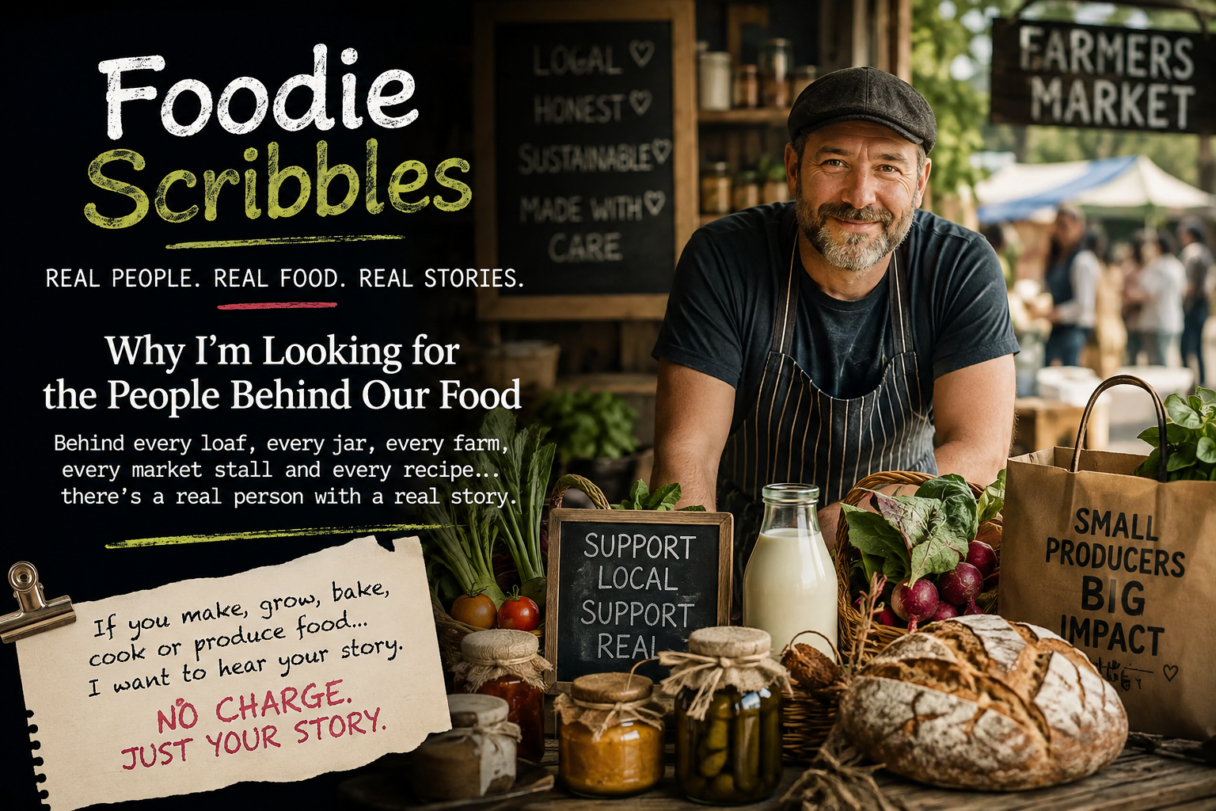
Foodie Scribbles is about something rather simple… the people who make, grow, cook, bake, sell and care about the food we eat.
We know an extraordinary amount about the food we buy.
We can find out how many calories it contains, where it was manufactured, what allergens are hiding inside it, which supermarket has it cheapest and, if we’re sufficiently dedicated, whether the packaging can be recycled without requiring a degree in materials science.
What we often don’t know is the person behind it.
Who got up at four in the morning to start baking?
Who spent twenty years learning how to make that particular cheese?
Who grows the tomatoes on the little farm outside town?
Who stands behind a market stall every Saturday morning, rain or shine, hoping that enough people will stop to have a look?
Who decided, perhaps after years working for somebody else, that they were going to take a risk and start making something of their own?
Those are the stories that interest me.
That is why I started Foodie Scribbles.
Food is more than what’s on the plate
I’ve always thought that food has a rather remarkable ability to tell us something about the places where we live.
You can learn a surprising amount about a community by looking at its food.
Go to a farmers’ market and you aren’t simply looking at vegetables, bread, cheese, preserves or whatever happens to be available that morning. You’re looking at a network of people, skills, traditions and decisions that existed long before somebody put a price sticker on a jar.
A local producer might be using a recipe that has been in the family for generations. Another might be experimenting with something completely new. One might have inherited a farm. Another might have abandoned a perfectly sensible career because they wanted to make bread.
None of them necessarily has a marketing department.
Most don’t have a public relations agency.
They certainly don’t have somebody sitting in a glass office somewhere deciding that their carefully researched brand story needs to contain the phrase “authentic artisan journey”.
And perhaps that’s precisely why I find them interesting.
The people operating underneath the food industry
Modern food is a huge business.
It has enormous companies, sophisticated supply chains, international distribution networks, algorithms deciding what appears in front of us and marketing budgets that would make most independent producers quietly lie down in a darkened room.
There is nothing inherently wrong with any of that. Large-scale food production has its place, and feeding millions of people isn’t exactly something you can organise with a trestle table and a handwritten sign.
But somewhere underneath all that machinery there is another food economy.
It is smaller.
It is often local.
It is frequently independent.
And it is full of people doing things because they genuinely care about what they produce.
The baker who knows which customers will arrive at seven on Saturday morning.
The farmer who knows exactly which field produced this year’s crop.
The cheesemaker who can tell you why one batch tastes slightly different from the last.
The person making chutney in a kitchen that is considerably smaller than anything bearing the word “production facility”.
The family-run café where somebody still knows what you normally order.
The butcher who can explain where the meat came from rather than simply pointing towards a laminated photograph of a smiling cow.
These businesses may be small, but small doesn’t mean insignificant.
In many cases, they are part of what makes a place feel like itself.
So why tell their stories?
Because I think we’re losing some of them.
Not necessarily because the people disappear, although sadly that happens too.
Sometimes the story simply disappears because nobody thought it was worth telling.
A business closes.
A market disappears.
A family recipe isn’t passed on.
A producer gives up because the numbers no longer work.
A small shop is replaced by something that looks remarkably similar to the one in the next town.
And eventually someone says, “It used to be really good here.”
I’ve heard versions of that sentence in enough places to know that it isn’t just nostalgia.
There is something worth preserving in local food culture.
Not everything old is automatically good, of course. That would be a rather dangerous principle to apply to dentistry, plumbing or military equipment.
But skills, knowledge, recipes, businesses and relationships between producers and communities have value.
They form part of the character of a place.
And sometimes all it takes to keep a story alive is for somebody to actually ask the person to tell it.
This isn’t a restaurant review site
Foodie Scribbles isn’t intended to become another collection of restaurant reviews.
I’m not particularly interested in giving somebody three stars because the chair was uncomfortable or deducting half a point because my coffee arrived thirty-seven seconds later than I expected.
I’m much more interested in why they are there in the first place.
What made them start?
What have they learned?
What went wrong?
What went right?
What keeps them going when running a small food business becomes an exhausting combination of early mornings, rising costs, paperwork, weather, customers, regulations and the occasional desire to throw the entire till into a nearby river?
What makes them proud?
What does their food mean to them?
And perhaps most importantly… what would they like people to know?
Those questions can produce a much more interesting story than a review ever could.
I want to find the people you probably haven’t heard of
This is the bit I’m particularly interested in.
I don’t need another article telling me which multinational food brand has just launched its latest product.
There are plenty of people already covering that.
I’m interested in the person with a stall at the local market.
The independent baker operating from a tiny premises.
The farmer producing something unusual.
The family making preserves.
The small cheesemaker.
The independent butcher.
The café owner who has somehow kept going for twenty years.
The person selling homemade food at a local festival.
The growers, producers, cooks, makers and traders who are doing something interesting but don’t necessarily have the resources, time or inclination to shout about themselves online.
Some of the best stories are probably sitting ten miles from where you live.
You just have to notice them.
And I want to connect them with local food
There is another reason for doing this.
I think we have become remarkably disconnected from the origins of what we eat.
Food can travel thousands of miles before it reaches us. We can buy strawberries in winter, vegetables from another continent and products whose ingredients have travelled through half a dozen countries before ending up in a packet on a supermarket shelf.
Again, there are good reasons for some of that.
But there is something rather satisfying about buying food from somebody who can point towards the field where it was grown.
Or buying bread from the person who actually made it.
Or finding a cheese produced a few villages away.
Or discovering that the person selling something at the Saturday market has been doing it for longer than some of the people buying it have been alive.
Local food isn’t simply about geography.
It is about relationships.
You begin to know where something came from.
You know who made it.
You start asking questions.
And occasionally you discover something wonderful that you would never have found through an algorithm recommending “10 foods you absolutely MUST try before Tuesday”.
And here’s the important bit…
I don’t want money for these stories.
I’m deliberately saying that because it seems increasingly unusual.
If you’re an independent food producer, small business owner, farmer, market trader, baker, cook, grower or food maker and you have an interesting story to tell, I don’t want you to buy coverage from me.
There is no media package.
There is no “premium exposure opportunity”.
There is no invoice waiting mysteriously in my inbox.
There is no requirement to purchase advertising before I will consider writing about you.
If I think your story is interesting, I want to tell it.
That’s it.
I’m doing this because I like stories.
I like food.
I like independent businesses.
And I rather like the idea of shining a small light on people who are doing worthwhile things without an enormous budget behind them.
That doesn’t mean every story has to be perfect
In fact, I’d much rather hear about the difficult bits as well.
Running an independent food business isn’t some picturesque Instagram existence involving rustic wooden tables and a perfectly positioned sourdough loaf.
There are bills.
There are failures.
There are long days.
There are regulations.
Some ingredients suddenly become ridiculously expensive.
Some customers complain because apparently the universe has personally offended them by charging £4 for something that took three hours to make.
There are moments when the sensible thing would probably be to get a normal job.
And yet people keep doing it.
Why?
That’s a story worth hearing.
Foodie Scribbles is really about people
That’s the simplest way I can explain what I’m building.
Food is the doorway.
The people are the reason I’m walking through it.
I want to discover the independent food businesses that make their communities interesting. I want to hear from farmers and producers. I want to find the people behind the market stalls and the little shops. I want to discover the family recipes, the new ideas, the failures, the successes and the strange journeys that eventually lead somebody to putting food in front of another human being and saying, “Try this.”
Some stories will be about exceptional food.
Others might be about ordinary food made by extraordinary people.
Some will be deeply rooted in tradition.
Others will be completely new.
Some businesses will be thriving.
Others might simply be hanging on.
That’s fine.
I’m not looking for perfection.
I’m looking for something real.
So… who should I be talking to?
Perhaps it’s you.
Perhaps it’s somebody you know.
Perhaps there is a baker, farmer, producer, market trader, café owner, grower, cheesemaker, butcher, cook or food entrepreneur in your town whose story deserves to be heard.
If so, tell me about them.
If you’re that person yourself, tell me about you.
I’d like to know what you make, where you are, how you started, what you’ve learned and why you’re still doing it.
And if your story is interesting, I’ll tell it.
For free.
Because I don’t think every good story needs a price attached to it.
Sometimes it just needs somebody to listen.
And perhaps, somewhere between the supermarket aisle and the Saturday market, we might start paying a little more attention to the people who actually make our food.
That’s where Foodie Scribbles begins.
🍞 TELL ME YOUR FOOD STORY
If you’re an independent food producer, baker, farmer, market trader, cook, grower or food business with a story worth telling, I’d like to hear it.
No charge. No advertising package. No catch.
Just email me at dominus@foodiescribbles.com
Then:
🥕 FOLLOW FOODIE SCRIBBLES
Come along for the journey as we discover the real people, local produce and independent food businesses behind the food we eat.
Related Posts