Elisabeth Luard…The Woman Who Knew Every Recipe Had a Passport
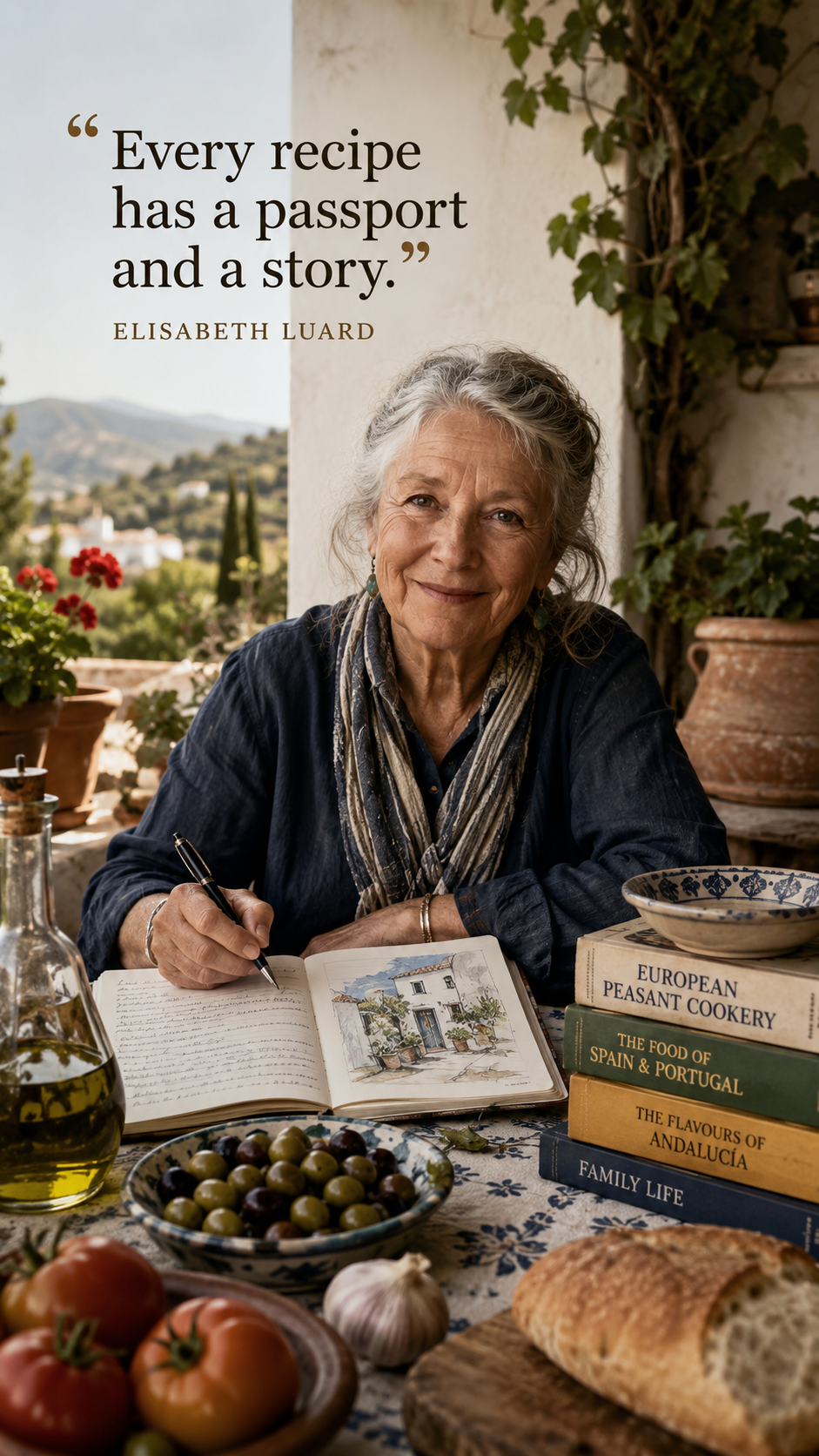
By Dominus Owen Markham
Some people collect recipes.
Others collect stories.
Elisabeth Luard spent a lifetime proving that the two were never really separate.
Long before television chefs were racing around the world searching for “hidden food gems”, Luard was already sitting in ordinary kitchens, drinking coffee that had probably been brewed three times already, listening to grandmothers explain why the rabbit had to be cooked slowly and why olive oil from one valley never quite tasted like olive oil from the next.
She wasn’t chasing perfection.
She was documenting memory.
And Britain is a richer place because she did.
A Life That Refused To Stay Still
Elisabeth Luard never planned to become one of Britain’s most respected food writers.
Life simply carried her there.
Born in England in 1942, she married the writer and traveller Nicholas Luard, and together they embarked on an extraordinary journey that would take them across Europe, the Middle East and beyond.
This wasn’t luxury travel.
There were children.
Limited money.
Old vehicles that probably broke down more often than they worked.
Meals weren’t planned around restaurant bookings.
They were whatever local people happened to be cooking that day.
And that made all the difference.
Because the best recipes rarely begin in restaurants.
They begin in someone’s home.
Spain Before It Became Fashionable
Today, everyone seems to have discovered Mediterranean cooking.
Olive oil.
Fresh tomatoes.
Simple ingredients.
Seasonality.
You can scarcely move through a bookshop without finding another glossy cookbook celebrating them.
When Luard began writing about Spain, it was different.
Many parts of rural Spain were still poor.
Families wasted nothing.
Bread became soup.
Leftovers became tomorrow’s lunch.
Vegetables weren’t fashionable.
They were simply what happened to be growing.
Living here in Andalucía, I still see echoes of that approach.
The elderly neighbour who grows beans because that’s what he’s always done.
The tiny village bakery where yesterday’s loaf still has value.
The local olive press where everyone knows whose trees produced which oil.
None of it is performed for tourists.
It’s simply life.
Luard understood that before much of Britain even noticed.
Ordinary People Make Extraordinary Food
One of the things I admire most about Elisabeth Luard is who she chose to celebrate.
Not celebrity chefs.
Not television personalities.
Not culinary empires.
Ordinary families.
Farmers.
Fishermen.
Village cooks.
Women who had never written a cookbook in their lives but somehow knew exactly when the stew was ready simply by its smell.
Those people fascinated her.
Quite rightly.
Because they are the people who quietly preserve food culture while everyone else is busy arguing about trends.
Simplicity Isn’t Laziness
Modern food has developed an odd relationship with complexity.
More ingredients.
More techniques.
More gadgets.
More spectacle.
Yet some of the finest meals I’ve eaten in Spain contained remarkably little.
Good tomatoes.
Fresh bread.
Olive oil.
Cheese.
Perhaps a little cured ham.
That was enough.
Luard spent years reminding readers that simplicity is not the absence of skill.
It’s often the highest expression of it.
When ingredients are honest, they don’t need disguising.
Writing Before Influencing
There’s another reason I wanted to feature Elisabeth Luard.
She belongs to a generation that wrote before anyone worried about algorithms.
Her books weren’t trying to go viral.
They were trying to preserve knowledge.
Every recipe came wrapped inside a story.
Who cooked it.
Where it came from.
Why that ingredient mattered.
What was happening around the table.
That’s the sort of writing that ages well.
Because fashions change.
People don’t.
The Quiet Importance Of Memory
Food has always been history written in edible form.
Every migration leaves behind recipes.
Every hardship invents new dishes.
Every celebration creates traditions.
If we lose those stories, we lose far more than instructions for dinner.
We lose pieces of ourselves.
Elisabeth Luard seemed to understand that instinctively.
She wasn’t merely recording recipes.
She was recording people.
What We Can Learn
We’re often encouraged to look for the next big thing.
The latest superfood.
The newest technique.
The hottest restaurant.
Perhaps we should spend a little more time looking backwards.
Not because the past was better.
Because it still has something to teach us.
Cook more simply.
Waste less.
Eat together.
Know where your food came from.
Listen to older people before their stories disappear.
It isn’t nostalgia.
It’s common sense served on a plate.
Five Things You May Not Know
• Elisabeth Luard travelled across Europe with her family, collecting recipes from ordinary households rather than famous restaurants.
• Her landmark book European Peasant Cookery helped introduce generations of British readers to authentic regional cooking.
• She has written more than a dozen books celebrating traditional food cultures.
• Spain has featured prominently throughout her work, particularly its rural cooking and respect for seasonal ingredients.
• She has spent decades championing the idea that recipes are part of our cultural heritage, not simply instructions for preparing food.
If You’d Like To Know More
Start here:
• The Food of Spain & Portugal
• Her regular newspaper and magazine columns exploring traditional European cooking.
Foodie Scribbles Reflection
The world doesn’t really need another celebrity telling us how to make the perfect fifteen-minute dinner.
What it needs is more people reminding us why food mattered long before television cameras arrived.
It mattered because every loaf, every stew and every family recipe represented a conversation between generations.
Someone taught someone else.
Someone remembered.
Someone cared enough not to let it disappear.
Elisabeth Luard has spent much of her life making sure those conversations weren’t lost.
Perhaps that’s the greatest recipe of all.
What this becomes over time will depend on the people who step into it.
But the intention is straightforward.
To document the food world as it actually is… not just as it is presented.
And in doing so… to give a bit more space to the ones quietly getting on with it.
Reader Recipe Corner: Share Your Culinary Creations! 🍽️
We want to hear from you! Do you have a cherished recipe that brings your family together? Maybe a secret dish that never fails to impress? Share your culinary creations with us! Please submit your favourite recipe, along with a photo, and get a chance to be featured in our next newsletter. Let’s celebrate the joy of cooking together—your delicious ideas could inspire fellow food lovers!
Click the button below to send us your recipes! We can’t wait to see what you’ve been cooking up! 🥘❤️
Closing Thoughts: Until Next Time! 🌟
As we wrap up this edition of Foodie Scribbles, we hope you’re feeling inspired to get into the kitchen and whip up some delightful dishes! Don’t hesitate to experiment with the recipes, indulge in the flavours of our featured restaurant, and explore seasonal ingredients that are just waiting for your culinary touch.
We’d love to hear from you! Share your cooking adventures, dining experiences, or your own tips and tricks. Your insights are what make our foodie community flourish!
Until next time, keep cooking, keep tasting, and keep sharing the joy of food! 🍽️❤️✨
Related Posts